

Recently, headlines around the Johor–Singapore Special Economic Zone (JS-SEZ) have been dominating major financial outlets. For business owners and overseas investors actively searching for the Best Industrial Zone in Malaysia, every policy shift in Southern Malaysia now reads like a market signal.
This isn’t simply another investment promotion campaign. It’s closer to a global supply-chain “land-grab” moment — where positioning early can define the next decade. As Singapore and Malaysia deepen cooperation across cross-border trade, talent mobility, and tax incentives, industrial land prices and rental demand in Johor are entering a new growth cycle.
From current market observation, even the long-standing “Malaysia industrial zone rankings” are starting to shift. Historically, the Klang Valley and Penang have held the top spots. But as Malaysia–Singapore collaboration enters a new phase in 2026, many companies are reassessing where the real upside is — and increasingly, the answer points to regions that can execute cross-border coordination at scale.
So the bigger question becomes: what kind of foundation truly deserves the label “Malaysia’s Best Industrial Zone”? In many cases, the market is now rewarding places that connect international trade routes with strategic energy and industrial infrastructure — not just “industrial land.”
Strategic Positioning: Why the “Best Industrial Zone in Malaysia” Spotlight Is Shifting Toward Pengerang
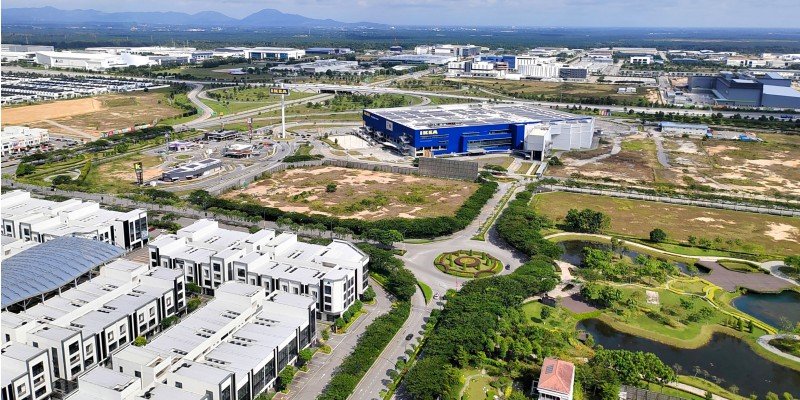
If you look at Malaysia’s industrial map, Pengerang sits in a uniquely powerful position. As a key pillar in the broader economic-zone strategy, it has Singapore — a global finance and tech hub — on one side, and Malaysia’s US$27 billion PETRONAS RAPID integrated petrochemical complex on the other.
This “two-engine adjacency” gives Pengerang a structural advantage in the competition for the Best Industrial Zone in Malaysia title.
From a news and policy perspective, Pengerang’s rise is not random — it’s a natural outcome of Malaysia’s national energy strategy combined with regional economic integration. With proximity to deep-water port capacity, the area inherits a natural edge as a port-adjacent industrial zone, capable of supporting large-scale import/export flows and light, medium & heavy industry logistics.
In this context, entities like Pengerang Industrial Hub (PIH) often play an administrative and facilitation role — connecting incoming investors with surrounding infrastructure and energy ecosystems. For downstream petrochemical players that rely on raw material access from RAPID, distance is competitiveness. And PIH’s reported proximity — about 4 km from RAPID — is one of its strongest “hard advantages.”
From RAPID to Singapore: The Logic Behind a “World-Class Supply Chain” Setup

Why are advanced manufacturing players across Asia increasingly looking toward Johor?
The logic is simple: risk management + efficiency. In a volatile global trade climate, companies don’t just want a place to produce. They want a base that stays resilient, ships fast, and adapts to disruption.
A truly competitive advanced manufacturing zone in Malaysia must deliver production readiness and outbound speed. This is why Pengerang, under a “multi-modal logistics” framework. It is quickly rising as a new favorite in the category of Malaysia logistics industrial zones.
By observing recent investor interest patterns, more China-linked and Taiwan-linked manufacturers are paying attention to the area’s sea–land–air connectivity and cross-border link to Singapore. The model is straightforward: leverage Singapore’s global shipping and finance networks, while operating within Malaysia’s more cost-efficient industrial environment.
This “near-Singapore industrial base in Malaysia” structure is actively reshaping the Southeast Asia manufacturing map. For business owners searching for opportunities in Malaysia export manufacturing zones, Pengerang isn’t just offering land — it’s offering a faster route to global markets.
ROI Comparison: Infrastructure Dividends and the Real Meaning of “Best Industrial Zone in Malaysia”
In finance, the ultimate question is always ROI — specifically industrial zone investment returns in Malaysia.
Instead of chasing saturated legacy industrial areas with aging infrastructure, capital is increasingly flowing to zones built with “future readiness” as a default. If you compare industrial parks in Malaysia today, newer-generation zones tend to prioritize:
- ESG-aligned planning (environment, social, governance)
- digital infrastructure and connectivity
- logistics throughput and redundancy
- grid stability and industrial-grade utilities
Pengerang’s infrastructure is in a rapid upgrade phase. Wide logistics corridors, stable high-voltage power availability, and expanding high-speed communications are becoming key reasons businesses accept pricing premiums.
Compared to older zones that face frequent congestion, grid instability, or “hidden costs” of inefficiency, newly planned growth zones can reduce operational friction dramatically.
In other words, industrial land logic in Malaysia is shifting — from “buy land and wait for appreciation” to “pay for efficiency and scale.” This is a major reason modern hubs like PIH are moving upward in perceived industrial-zone ranking discussions.
History tends to repeat: companies that position early in a new economic-zone cycle often become the biggest winners.
As JS-SEZ supporting policies and infrastructure continue to roll out through 2026, Pengerang is evolving beyond a single-purpose energy base. It’s becoming a more diversified, potentially world-class industrial platform.
Searching for the Best Industrial Zone in Malaysia is ultimately about finding a location that aligns. It with national planning and long-term industrial direction. Whether your business is downstream petrochemicals, advanced manufacturing, or cross-border logistics, Pengerang’s emerging combination of:
- energy access
- port adjacency
- special economic zone momentum
creates a “triple dividend” that is difficult to replicate elsewhere in Malaysia.
Pengerang is no longer just a place name — it’s a symbol of Malaysia’s manufacturing upgrade and supply-chain repositioning. For decision-makers with a long view, securing a position here may be less about today’s headlines. And more about locking in the next decade’s growth blueprint.