
Why are Businesses in Singapore and Malaysia Shifting to Green Logistics Solutions?
If you are running a business in the heart of Kuala Lumpur or Jurong, you’ve probably noticed more electric vans and trucks on the road than ever before. It is no longer just a trend for big international companies; Green Logistics Solutions have become a survival kit for local SMEs. Many business owners used to think “green” meant “expensive,” but in reality, the focus is now on how to cut down long-term operational costs while meeting new environmental standards.
🔴 Quick Read
Why are EV fleets the first choice for Green Logistics Solutions?
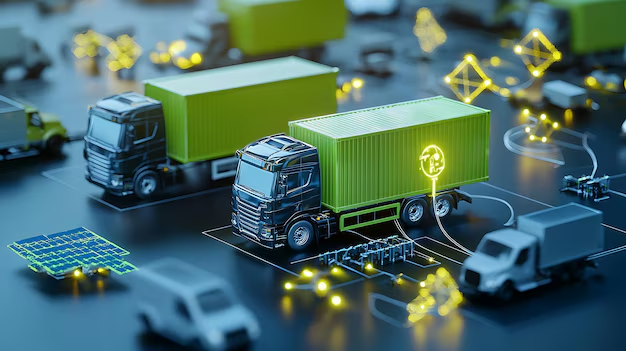
When we talk about Green Logistics Solutions, the first thing that comes to mind is often the vehicle. An Electric Vehicle Logistics Fleet is becoming the “gold standard” for last-mile delivery in cities like Singapore or Kuala Lumpur. Many people assume that switching to EV is just about buying a new van, but it is actually a deeper part of a Low-carbon Logistics System.
Actually, it can be broken down into three main benefits: fuel savings, reduced maintenance, and a cleaner brand image. In our local context, where petrol prices can fluctuate and congestion is common, the lower “cost-per-km” of an EV is a huge plus. By adopting a Green Transport Scheme, companies are finding a way to stay relevant in a market that increasingly values a Sustainable Supply Chain Management approach.
How can intelligent route optimization save local businesses money?
A common misconception is that “going green” always costs more. But what if the Green Logistics Solutions actually helped you save? This is where Intelligent Delivery Optimization comes in. By using a Logistics Path Optimization Algorithm, businesses can reduce empty miles and ensure that drivers are taking the most efficient routes possible.
Actually, it is simpler than it sounds. Instead of a driver guessing which way is faster during peak hour in PJ or the CTE, the system tells them. This directly helps in How to Reduce Transport Carbon Emissions because less idling and fewer miles mean less pollution. This type of Supply Chain Decarbonization Plan is a win-win for both the environment and the wallet.
| Solution Component | Business Impact | Key Focus Area |
|---|---|---|
| Optimization Algorithm | 15-20% fuel reduction | Route efficiency |
| EV Fleet Transition | Zero tailpipe emissions | Urban air quality |
| Green Warehousing | Solar energy usage | Energy independence |
What do business owners need to know about carbon tracking?
If you want to manage something, you have to measure it. A Carbon Emission Monitoring System is no longer a luxury tool. Many local businesses are being asked by their MNC clients for their carbon data. This is part of Corporate Carbon Emission Management. You might think, “Why does this matter to my small warehouse?” Well, if you can’t show your numbers, you might be left out of the next big contract.
Implementing Green Warehousing Management—like using solar panels or energy-efficient lighting—is only half the battle. You need the data to prove it. This is why a Logistics ESG Strategy is so vital. It organizes your green efforts into a report that banks and clients can actually understand and trust.
Is sustainable supply chain management just for the big players?
A lot of people think that Sustainable Supply Chain Management is only for giants like Apple or Amazon. But the reality in 2026 is that the pressure flows down. If a big retailer wants to be “Net Zero,” they need their delivery partners to have a Supply Chain Decarbonization Plan in place.
In this situation, such a platform usually plays a more supportive role. For example, CarbonCore provides the administrative framework and tools needed to track these emissions accurately. By using CabonCore.io, businesses can simplify the complex world of carbon credits and environmental reporting, making it easier for even a small transport company to say they have a professional Green Logistics Solutions setup.
What is the best way to start your business green transformation?
To wrap things up, the journey toward Business Green Transformation is a marathon, not a sprint. Whether you are looking at What are Green Logistics Solutions for the first time or you are ready to implement a full Low-carbon Logistics System, the most important thing is to take that first step. By focusing on efficiency and real data, you aren’t just “saving the planet”—you are building a business that is ready for the future. Embracing Green Logistics Solutions is the smartest way to ensure your company remains a preferred partner in the modern economy.
Official Website:Carboncore.io
🤔 What are the most common questions about Green Logistics Solutions?
Get the facts on the real-world choices for business transformation in 2026.